

Μια φορά και έναν καιρό, ήταν 25 στρατιωτάκια, όλα φτιαγμένα στο ίδιο καλούπι από μια παλιά μολυβένια κουτάλα. Ο τεχνίτης τα είχε ζωγραφίσει
πολύ όμορφα! Είχε κάνει κόκκινες τις στολές τους και μαύρα τα παντελόνια
τους και πράσινα τα καπελάκια τους με ένα κόκκινο φτερό.
Το ένα όμως στρατιωτάκι από λάθος είχε μόνο ένα πόδι.
Παρόλα αυτά το κουτσό στρατιωτάκι στεκόταν όρθιο όπως τα αλλά που είχαν
δυο πόδια. Ο τεχνίτης ενθουσιασμένος από τους μικρούς στρατιώτες που
έφτιαξε τους αράδιασε στη βιτρίνα του μαγαζιού με τέτοιο τρόπο που έδιναν
την εικόνα ενός μικρού στρατού.
Κάποια μέρα ένα ανδρόγυνο αφού θαύμασε αρκετή ώρα την βιτρίνα με τα στρατιωτάκια μπήκε στο μαγαζί και τα αγόρασε όλα για να τα κάνει δώρο στη γιορτή του μικρού τους γιου.

Ο μικρός μόλις άνοιξε το κουτί και αντίκρισε το μικρό στρατό έβγαλε
μια φωνή από την χαρά του.
"Αχού τι ωραία στρατιωτάκια, σας ευχαριστώ που για το δώρο,
θα τα βάλω αμέσως κάτω να παίξω. "
Αμέσως λοιπόν τα έστησε επάνω στο τραπέζι μαζί με τα άλλα δώρα πλάι
στο ανάπηρο στρατιωτάκι στεκόταν στο ένα της πόδι σε μια χορευτική
φιγούρα μια κούκλα μπαλαρίνα που φορούσε ένα κοντό φορεματάκι.
Το στρατιωτάκι μόλις αντίκρισε την κούκλα δίπλα του αισθάνθηκε ένα
σκίρτημα στην καρδιά του. Αυτή η γυναίκα είναι για μένα είπε.
Κρύφτηκε πίσω από έναν χάρτινο πύργο και περίμενε να νυχτώσει για
να πάει κρυφά από τα άλλα στρατιωτάκια να της μιλήσει.
Το βράδυ λοιπόν μόλις τα παιδιά πήγαν για ύπνο και στο σπίτι έπεσε
σκοτάδι και σιωπή το στρατιωτάκι άρχισε να ψάχνει να βρει την πανέμορφη μπαλαρίνα μα πουθενά. Κουρασμένος μετά από αρκετή ώρα ξάπλωσε πάνω
στο τραπέζι και αποκοιμήθηκε.
Την άλλη μέρα το πρωί μόλις ξύπνησε το αγόρι πήγε κατευθείαν στο τραπέζι
με τα παιχνίδια πήρε τον κουτσό στρατιώτη και τον έβαλε στο έξω περβάζι του παράθυρου για να φυλαει το σπίτι. Σε λίγο έπιασε δυνατή βροχή και δυο παιδιά που περνούσαν απέξω στάθηκαν κάτω από την μαρκίζα του παραθύρου για να
μη βραχούν.
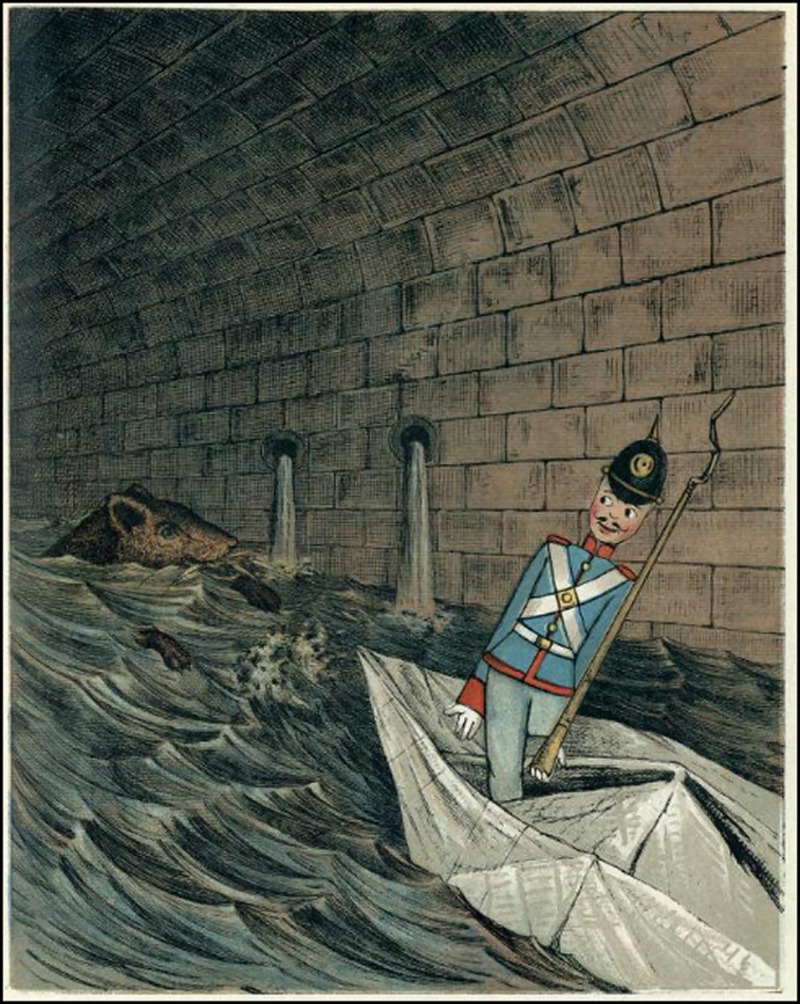
Κάποια στιγμή είδαν το κουτσό στρατιωτάκι και το πήραν. Αφού έφτιαξαν ένα χάρτινο καραβάκι έβαλαν επάνω το μικρό στρατιωτάκι και το έβαλαν με προσοχή πάνω στην επιφάνεια του νερού που κυλούσε στο ρυάκι του δρόμου. Ο μικρός στρατιώτης ταξίδεψε έτσι πάνω στο φύλλο για πολύ ώρα ώσπου κάποια στιγμή έφτασε σε έναν αγωγό που τον παρέσυρε σε έναν σκοτεινό υπόνομο.
- Αχ! τι πυκνό σκοτάδι είναι αυτό εδώ μέσα;
- Αχ! τι καλά που ήταν να είχα την αγαπημένη μου χορεύτρια εδώ δίπλα μου.
Ξαφνικά την ησυχία του υπονόμου αναστάτωσαν στριγκλιές από τα ποντίκια
που κατοικούσαν εκεί και ένας χοντρός ποντικός παρουσιάστηκε μπροστά του
και του είπε:
- Για πες μου φιλαράκο πως βρέθηκες εσύ εδώ μέσα;
- Δεν ξέρεις πως εδώ είναι περιοχή ελεγχόμενη από εμάς τα ποντίκια;
- Έκανες παρά πολύ άσχημα που τρύπωσες στο σπίτι μας.
Το στρατιωτάκι χωρίς να δώσει καμία απάντηση συνέχισε το ήρεμο ταξίδι του
στο φυλλαράκι που το παρέσυραν μακριά τα νερά του υπονόμου.
Τα ποντίκια θυμωμένα από την περιφρόνηση του στρατιώτη όρχησαν
αμέσως να φωνάζουν:
- Πιάστε τον, πιάστε τον μην το αφήσετε να απομακρυνθεί…
- Αυτός είναι κατάσκοπος... κατάσκοπος!
Τα νερά του υπονόμου σύντομα έφτασαν στη θάλασσα, μεγάλα κύματα αναποδογύρισαν το μεγάλο πλατύφυλλο και ο μικρός μολυβένιος στρατιώτης άρχισε να βυθίζεται στα βαθιά νερά…

Όταν ένα μεγάλο ψάρι τον πλησίασε γρήγορα άνοιξε το στόμα του και
τον κάταπιε ολόκληρο.
- Πωπωωω τι πυκνό σκοτάδι είναι εδώ μέσα…
Το μικρό στρατιωτάκι δεν έχασε το θάρρος του έμεινε ακίνητο με το όπλο
στον ώμο του. Κάποια στιγμή το ψάρι άρχισε να σπαρταρά και να στριφογυρίζει σαν τρελό. Μετά από λίγο έμεινε ακίνητο και μετά από αρκετό χρονικό διάστημα κάποιος άνοιξε το στόμα του ψαριού και μια φωνή ακούστηκε:
- Αχ! απίστευτο το στρατιωτάκι μας που το παρέσυρε το ρυάκι πριν από μερικές μέρες βρίσκετε μέσα στο στόμα του ψαριού.
Τότε το στρατιωτάκι κατάλαβε τι είχε συμβεί…

Κάποιος ψαράς έπιασε το ψάρι το πήγε στην αγορά και το αγόρασε η μαγείρισσα που δούλευε στο σπίτι που ζούσε ο μικρός και οι γονείς του που έκαναν δώρο
για την γιορτή του τα μολυβένια στρατιωτάκια. Η μαγείρισσα πήρε προσεκτικά
το στρατιωτάκι από το στομάχι του ψαριού και το πήγε στο τραπέζι που ήταν
και τα άλλα στρατιωτάκια το μικρό αγόρι ξετρελαμένο από την χαρά του έπλυνε προσεκτικά το στρατιωτάκι τόκοι φάνηκαν πάλι λαμπερά τα ωραία χρώματα της στολής του.
Ο μικρός όμως στρατιώτης ήταν ζαλισμένος από την ξαφνική επιστροφή του
στο σπίτι και αισθανόταν ευτυχισμένος που βρισκόταν πάλι στην αγαπημένη του χορεύτρια. Τότε εκείνη γύρισε και κοίταξε επιτέλους το ανάπηρο στρατιωτάκι.
Η καρδιά της σκίρτησε από λαχταρά να τον αγγίξει.
Το στρατιωτάκι ένιωσε μια ευτυχία να πλημμυρίζει την καρδιά του.
Αλλα καθώς τα πράγματα πήγαιναν καλά για το ζευγάρι, μια μέρα που το αγόρι είχε τους φίλους του στο σπίτι ένα παιδί... άθελα του έσπρωξε το μικρό στρατιωτάκι και εκείνο έπεσε στο αναμμένο τζάκι. Αμέσως η στολή του τυλίχτηκε στις φλόγες.

- Αχ! Αχ! καίγομαι…. Καίγομαι…
Σιγά σιγά το στρατιωτάκι άρχισε να λιώνει με την σκέψη του όμως πάντα
στην πολυαγαπημένη του χορεύτρια.

Εκείνη την στιγμή η πόρτα άνοιξε από έναν δυνατό άνεμο και ο αέρας που
μπήκε στο δωμάτιο παρέσυρε την μικρή χορεύτρια και την έριξε και αυτή
στο τζάκι δίπλα στον αγαπημένο της στρατιώτη.
Άρχισε και αυτή λοιπόν να καίγεται πλάι του.
Την επόμενη μέρα, όταν η μαμά πήγε να μαζέψει τις στάχτες από
το τζάκι δεν βρήκε τίποτε άλλο, παρά μόνο μια μικρή μολυβένια καρδιά.
Έτσι τελείωσε η θλιβερή αυτή ιστορία του μικρού μολυβένιου στρατιώτη και της πανέμορφης χορεύτριας που χάθηκαν μαζί!

Το παραμύθι «Ο Μολυβένιος Στρατιώτης» (Den standhaftige tinsoldat) του Χανς Κρίστιαν Άντερσεν είναι ένα κλασικό έργο που έχει μεταφραστεί σε δεκάδες γλώσσες, ένα εξαιρετικό έργο που διδάσκει σε μικρούς και μεγάλους την διαφορετικότητα, την αποδοχή, τη δύναμη της αγάπης και της θυσίας.
The Brave Tin Soldier
by
Hans Christian Andersen
(1838)
THERE were once five-and-twenty tin soldiers, who were all brothers, for they had been made out of the same old tin spoon. They shouldered arms and looked straight before them, and wore a splendid uniform, red and blue. The first thing in the world they ever heard were the words, “Tin soldiers!” uttered by a little boy, who clapped his hands with delight when the lid of the box, in which they lay, was taken off. They were given him for a birthday present, and he stood at the table to set them up. The soldiers were all exactly alike, excepting one, who had only one leg; he had been left to the last, and then there was not enough of the melted tin to finish him, so they made him to stand firmly on one leg, and this caused him to be very remarkable.
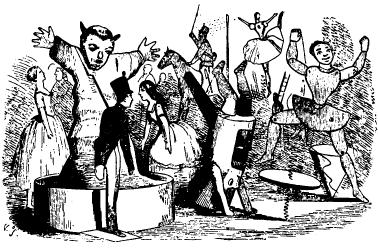
The table on which the tin soldiers stood, was covered with other playthings, but the most attractive to the eye was a pretty little paper castle. Through the small windows the rooms could be seen. In front of the castle a number of little trees surrounded a piece of looking-glass, which was intended to represent a transparent lake. Swans, made of wax, swam on the lake, and were reflected in it. All this was very pretty, but the prettiest of all was a tiny little lady, who stood at the open door of the castle; she, also, was made of paper, and she wore a dress of clear muslin, with a narrow blue ribbon over her shoulders just like a scarf. In front of these was fixed a glittering tinsel rose, as large as her whole face. The little lady was a dancer, and she stretched out both her arms, and raised one of her legs so high, that the tin soldier could not see it at all, and he thought that she, like himself, had only one leg. “That is the wife for me,” he thought; “but she is too grand, and lives in a castle, while I have only a box to live in, five-and-twenty of us altogether, that is no place for her. Still I must try and make her acquaintance.” Then he laid himself at full length on the table behind a snuff-box that stood upon it, so that he could peep at the little delicate lady, who continued to stand on one leg without losing her balance. When evening came, the other tin soldiers were all placed in the box, and the people of the house went to bed. Then the playthings began to have their own games together, to pay visits, to have sham fights, and to give balls. The tin soldiers rattled in their box; they wanted to get out and join the amusements, but they could not open the lid. The nut-crackers played at leap-frog, and the pencil jumped about the table. There was such a noise that the canary woke up and began to talk, and in poetry too. Only the tin soldier and the dancer remained in their places. She stood on tiptoe, with her legs stretched out, as firmly as he did on his one leg. He never took his eyes from her for even a moment. The clock struck twelve, and, with a bounce, up sprang the lid of the snuff-box; but, instead of snuff, there jumped up a little black goblin; for the snuff-box was a toy puzzle.
“Tin soldier,” said the goblin, “don’t wish for what does not belong to you.”
But the tin soldier pretended not to hear.
“Very well; wait till to-morrow, then,” said the goblin.
When the children came in the next morning, they placed the tin soldier in the window. Now, whether it was the goblin who did it, or the draught, is not known, but the window flew open, and out fell the tin soldier, heels over head, from the third story, into the street beneath. It was a terrible fall; for he came head downwards, his helmet and his bayonet stuck in between the flagstones, and his one leg up in the air. The servant maid and the little boy went down stairs directly to look for him; but he was nowhere to be seen, although once they nearly trod upon him. If he had called out, “Here I am,” it would have been all right, but he was too proud to cry out for help while he wore a uniform.
Presently it began to rain, and the drops fell faster and faster, till there was a heavy shower. When it was over, two boys happened to pass by, and one of them said, “Look, there is a tin soldier. He ought to have a boat to sail in.”
So they made a boat out of a newspaper, and placed the tin soldier in it, and sent him sailing down the gutter, while the two boys ran by the side of it, and clapped their hands. Good gracious, what large waves arose in that gutter! and how fast the stream rolled on! for the rain had been very heavy. The paper boat rocked up and down, and turned itself round sometimes so quickly that the tin soldier trembled; yet he remained firm; his countenance did not change; he looked straight before him, and shouldered his musket. Suddenly the boat shot under a bridge which formed a part of a drain, and then it was as dark as the tin soldier’s box.
“Where am I going now?” thought he. “This is the black goblin’s fault, I am sure. Ah, well, if the little lady were only here with me in the boat, I should not care for any darkness.”
Suddenly there appeared a great water-rat, who lived in the drain.
“Have you a passport?“ asked the rat, “give it to me at once.” But the tin soldier remained silent and held his musket tighter than ever. The boat sailed on and the rat followed it. How he did gnash his teeth and cry out to the bits of wood and straw, “Stop him, stop him; he has not paid toll, and has not shown his pass.“ But the stream rushed on stronger and stronger. The tin soldier could already see daylight shining where the arch ended. Then he heard a roaring sound quite terrible enough to frighten the bravest man. At the end of the tunnel the drain fell into a large canal over a steep place, which made it as dangerous for him as a waterfall would be to us. He was too close to it to stop, so the boat rushed on, and the poor tin soldier could only hold himself as stiffly as possible, without moving an eyelid, to show that he was not afraid. The boat whirled round three or four times, and then filled with water to the very edge; nothing could save it from sinking. He now stood up to his neck in water, while deeper and deeper sank the boat, and the paper became soft and loose with the wet, till at last the water closed over the soldier’s head. He thought of the elegant little dancer whom he should never see again, and the words of the song sounded in his ears—
“Farewell, warrior! ever brave,
Drifting onward to thy grave.”
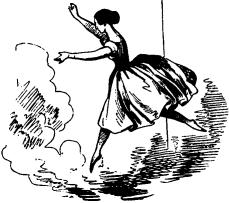 Then the paper boat fell to pieces, and the soldier sank into the water and immediately afterwards was swallowed up by a great fish. Oh how dark it was inside the fish! A great deal darker than in the tunnel, and narrower too, but the tin soldier continued firm, and lay at full length shouldering his musket. The fish swam to and fro, making the most wonderful movements, but at last he became quite still. After a while, a flash of lightning seemed to pass through him, and then the daylight approached, and a voice cried out, “I declare here is the tin soldier.” The fish had been caught, taken to the market and sold to the cook, who took him into the kitchen and cut him open with a large knife. She picked up the soldier and held him by the waist between her finger and thumb, and carried him into the room. They were all anxious to see this wonderful soldier who had travelled about inside a fish; but he was not at all proud. They placed him on the table, and—how many curious things do happen in the world!—there he was in the very same room from the window of which he had fallen, there were the same children, the same playthings, standing on the table, and the pretty castle with the elegant little dancer at the door; she still balanced herself on one leg, and held up the other, so she was as firm as himself. It touched the tin soldier so much to see her that he almost wept tin tears, but he kept them back. He only looked at her and they both remained silent. Presently one of the little boys took up the tin soldier, and threw him into the stove. He had no reason for doing so, therefore it must have been the fault of the black goblin who lived in the snuff-box. The flames lighted up the tin soldier, as he stood, the heat was very terrible, but whether it proceeded from the real fire or from the fire of love he could not tell. Then he could see that the bright colors were faded from his uniform, but whether they had been washed off during his journey or from the effects of his sorrow, no one could say. He looked at the little lady, and she looked at him. He felt himself melting away, but he still remained firm with his gun on his shoulder. Suddenly the door of the room flew open and the draught of air caught up the little dancer, she fluttered like a sylph right into the stove by the side of the tin soldier, and was instantly in flames and was gone. The tin soldier melted down into a lump, and the next morning, when the maid servant took the ashes out of the stove, she found him in the shape of a little tin heart. But of the little dancer nothing remained but the tinsel rose, which was burnt black as a cinder.
http://hca.gilead.org.il/tin_sold.html
https://www.youtube.com/watch?v=ajV-5qpvW1U


Δεν υπάρχουν σχόλια:
Δημοσίευση σχολίου