i-rena ... For those who don't know history and geography...by 'macedonian tomb' we mean GREEK tomb! Macedonia, like Epirus, Thrace, Thessaly,etc is part of Greece. *The title given to this article could be misleading and cause false expectations or impressions.... ---------------
Mosaic uncovered in northern Greece could mark royal Macedonian tomb
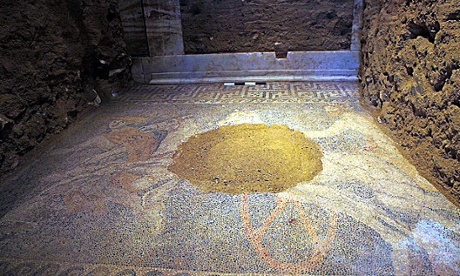
Archaeologists excavating Amphipolis site have discovered an intricate, and largely intact, floor mosaic dating back to 300BCtheguardian.com
The mosaic found at the mysterious Alexander The Great-era tomb near Amphipolis in the Macedonian region of northern Greece.Photograph: Handout/AFP/Getty
Two days after bones found in northern Greece were confirmed to be those of Alexander the Great’s father, archaeologists excavating a vast ancient tomb
in Amphipolis have uncovered an intricate floor mosaic that could signal another
royal Macedonian grave...
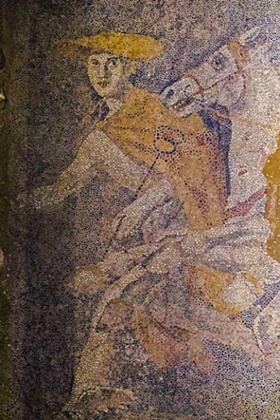
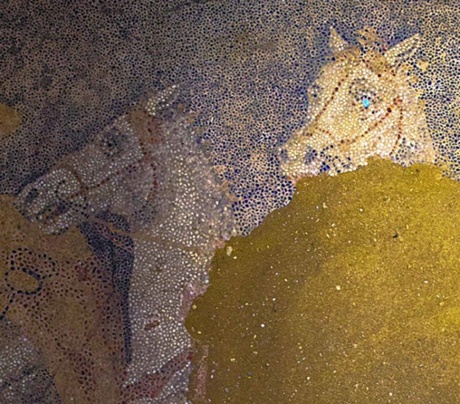
The mosaic, measuring three metres by 4.5 metres wide, depicts a horseman with a laurel wreath driving a chariot and two horses after Hermes, the Greek god of travel and guide to the underworld.
The ancient Greek god Hermes is depicted in a mosaic as the conductor of souls to the afterlife in this detail picture of the mosaic. Photograph: Greek Culture Ministry/AP
Made up of many coloured pebbles, the mosaic covers the whole floor of a room thought to be the antechamber to the main burial ground at Amphipolis, the largest ever found in Greece.
Hermes is depicted wearing a hat and cloak and carrying his caduceus, or staff. A circular part near the centre of the mosaic is missing, but authorities say enough fragments have been found nearby to reconstruct a large part.
According to an announcement on Sunday by the Greek culture ministry, the mosaic has been dated to the last quarter of 4th century BC (325-300BC), consistent with their belief that the grave contains the remains of a contemporary of Alexander the Great, the king of ancient Macedonia.
The mosaic consists of small white, black, grey, blue, red and yellow pebbles, depicting a chariot in motion. Photograph: Greek Culture Ministry/EPA
The grave may be that of a relative or general of Alexander, archaeologists have speculated. Some suggest it may even belong to his mother, Olympias, or his wife, Roxana.
Another team of Greek researchers confirmed on Friday that bones found in the late 1970s in a two-chamber royal tomb at Vergina, a town 100 miles away from Amphipolis, belonged to Alexander the Great’s father, King Philip II.
Alexander, who died in Babylon in present-day Iraq at 32, in 323BC, is believed to have been buried in Egypt but his tomb is yet to be found.



Δεν υπάρχουν σχόλια:
Δημοσίευση σχολίου