
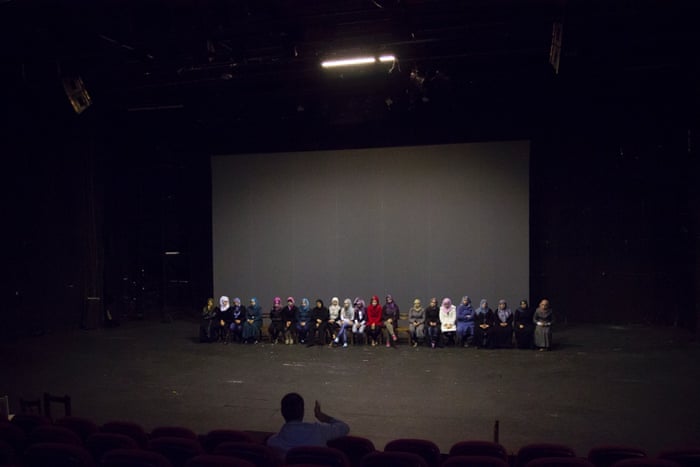
Omar Abu Saada directs the chorus.
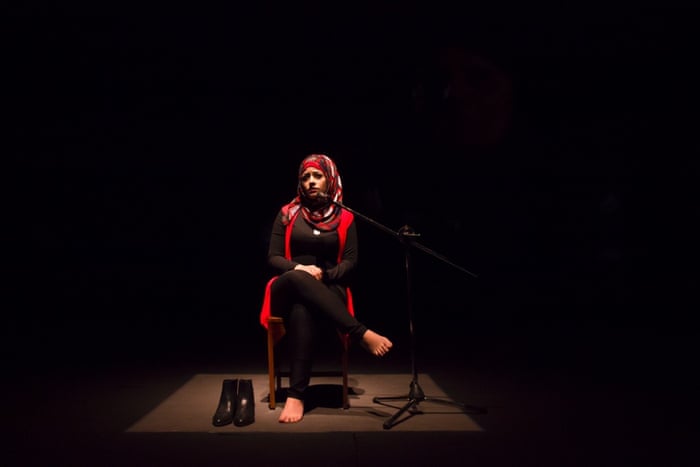
The final lines of the play have been rewritten in Syrian dialect,
and will be spoken by Sokari, a Palestinian-Syrian refugee from Damascus:
We didn’t realise how weak we were in front of the machine of war,
We didn’t realise how weak we were in front of the machine of war,
that we kept feeding it until it came and swallowed everything.
We don’t know what tomorrow holds, all we know is that the
Thebes that we used to know is finished’
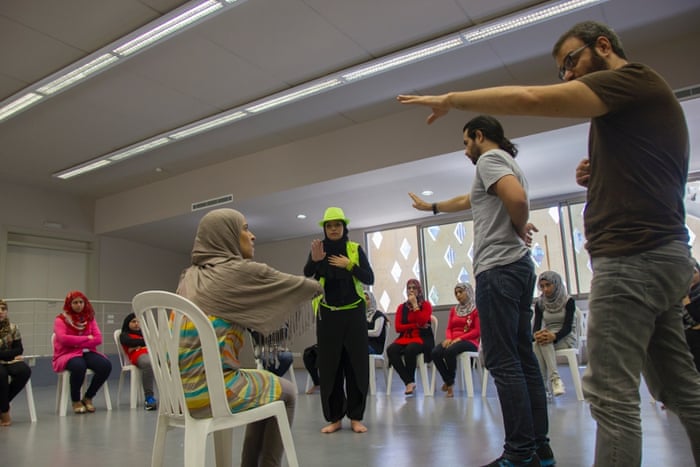
The play’s director, Syrian Omar Abu Saada (right), says:
‘The main theme of this text is a very important one for these women …
insurgency, rebellion, disobedience …
Did they do right or wrong in deciding to ask for freedom?’
This question has been endlessly discussed in rehearsals –
both whether Antigone is right to insist on doing what she believes
is moral despite the tragedy she brings, and whether the price Syrians
paying for challenging President Bashar al-Assad has been worth it,
with 191,000 people killed and half the population driven from their homes
‘The main theme of this text is a very important one for these women …
insurgency, rebellion, disobedience …
Did they do right or wrong in deciding to ask for freedom?’
This question has been endlessly discussed in rehearsals –
both whether Antigone is right to insist on doing what she believes
is moral despite the tragedy she brings, and whether the price Syrians
paying for challenging President Bashar al-Assad has been worth it,
with 191,000 people killed and half the population driven from their homes
A reimagining of Antigone by Syrian refugee women in Beirut throws up
timeless questions about gender, authority and insurrection, and is providing
a healing experience.
In Sophocles’s play, civil war in Thebes brings tragedy on a family and
on a national scale. Antigone wants to honour her dead brother against the
wishes of the state, and this act of rebellion results in her downfall
and condemnation for Thebes’ leader, Creon
on a national scale. Antigone wants to honour her dead brother against the
wishes of the state, and this act of rebellion results in her downfall
and condemnation for Thebes’ leader, Creon
The play runs 10-12 December at Theatre al-Madina in Beirut, Lebanon
State collapse from within, cities blown to rubble.’
These lines from Sophocles’s 2,400-year-old Greek play Antigone
could have been written about Syria today.
A group of Syrian refugee women in Beirut are creating
a new version of the play, Antigone of Syria,
by intertwining their stories of revolution and suffering
with those of the ancients
These lines from Sophocles’s 2,400-year-old Greek play Antigone
could have been written about Syria today.
A group of Syrian refugee women in Beirut are creating
a new version of the play, Antigone of Syria,
by intertwining their stories of revolution and suffering
with those of the ancients
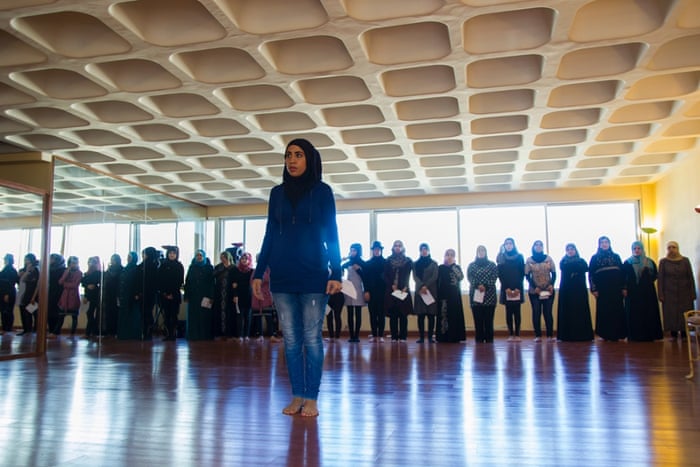
Hiba Sahly, 23, shares the story of Antigone herself –
she has lost two brothers, one of whom she has been unable
to bury due to the war in her country.
Her testimony of loss has become part of the play.
She says: ‘I understand why Antigone does what she does.
If I could go to Syria and bury my brother with my
own hands, I would do it’....
she has lost two brothers, one of whom she has been unable
to bury due to the war in her country.
Her testimony of loss has become part of the play.
She says: ‘I understand why Antigone does what she does.
If I could go to Syria and bury my brother with my
own hands, I would do it’....
[....]


Δεν υπάρχουν σχόλια:
Δημοσίευση σχολίου